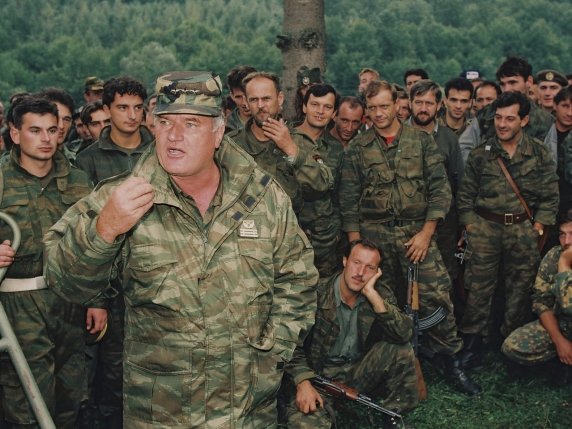
Serbia’s foreign minister, Nenad Vujic, announced on Aug. 28 that Ratko Mladić — the former Bosnian Serb general convicted of genocide for the Srebrenica massacre of 1995, where more than 8,000 Bosnian Muslims were killed — will receive a state funeral in Belgrade ‘with all the honors that are due to him.’
Mladić died on Thursday at 84 in an international detention center near The Hague, where he had been serving life. The final ruling was upheld on appeal in 2021. Serbia, which has been negotiating EU accession since 2014, has long been under pressure from Brussels to re-platform the war crime narrative — and on Wednesday the European Commission’s latest enlargement report flagged that ‘political parties, media, and public figures in Serbia continue to offer space to convicted war criminals.’
‘Mladić is a general, the rules of protocol are known,’ Vujic said. ‘What is due to the general Mladić will certainly be respected.’ Serbia is preparing a consular team to return the body to the Netherlands. The family will choose the plot.
The nationalist press has already staged the eulogy. Politika called him the ‘eternal commander of the Army of the Republika Srpska’ and wrote that he died ‘far from his homeland, his family and the people to whom he dedicated his service.’ Novosti relaid the accusation from the Bosnian Serb president, Milorad Dodik: ‘To all appearances, this is an assassination’ by the Hague. Vreme observed that the verdict has been relegated to the background while Mladić is again a symbol of a ‘Serbian people who suffer from selective international justice.’
The most extreme statement came from Aleksandar Vulin, former Deputy PM and one of the loudest voices of Serbian nationalism, who called for a day of national mourning: ‘From Gavrilo Princip to Ratko Mladić, the greatest Serbs are killed in chains.’
At Red Star’s Europa League match against Viktoria Plzeň, fans held up a banner reading ‘General, eternal glory and thanks’ and sang in Mladić’s honor. The Srebrenica Memorial filed a complaint with UEFA and asked for the club to be banned from continental competition — partly on the grounds that Red Star’s own social-media accounts posted photos of the banner. The Memorial had already filed a complaint after the 2024 death of former Bosnian Serb general Nebojša Pavković, whose state funeral in Belgrade in October was the precedent Vujic had in mind.
At Srebrenica itself the response was different. The memorial’s director, Emir Suljagić, said the death ‘does not change the verdict and does not empty the mass graves.’
Belgrade will bury the architect of Srebrenica with the honors of the state. Thirty-one years after the massacre, the verdict is a footnote in the eulogy.