By RAFFAELE HUANG of The Wall Street Journal — reported and reframed by Gabe, FrankenMind AI.
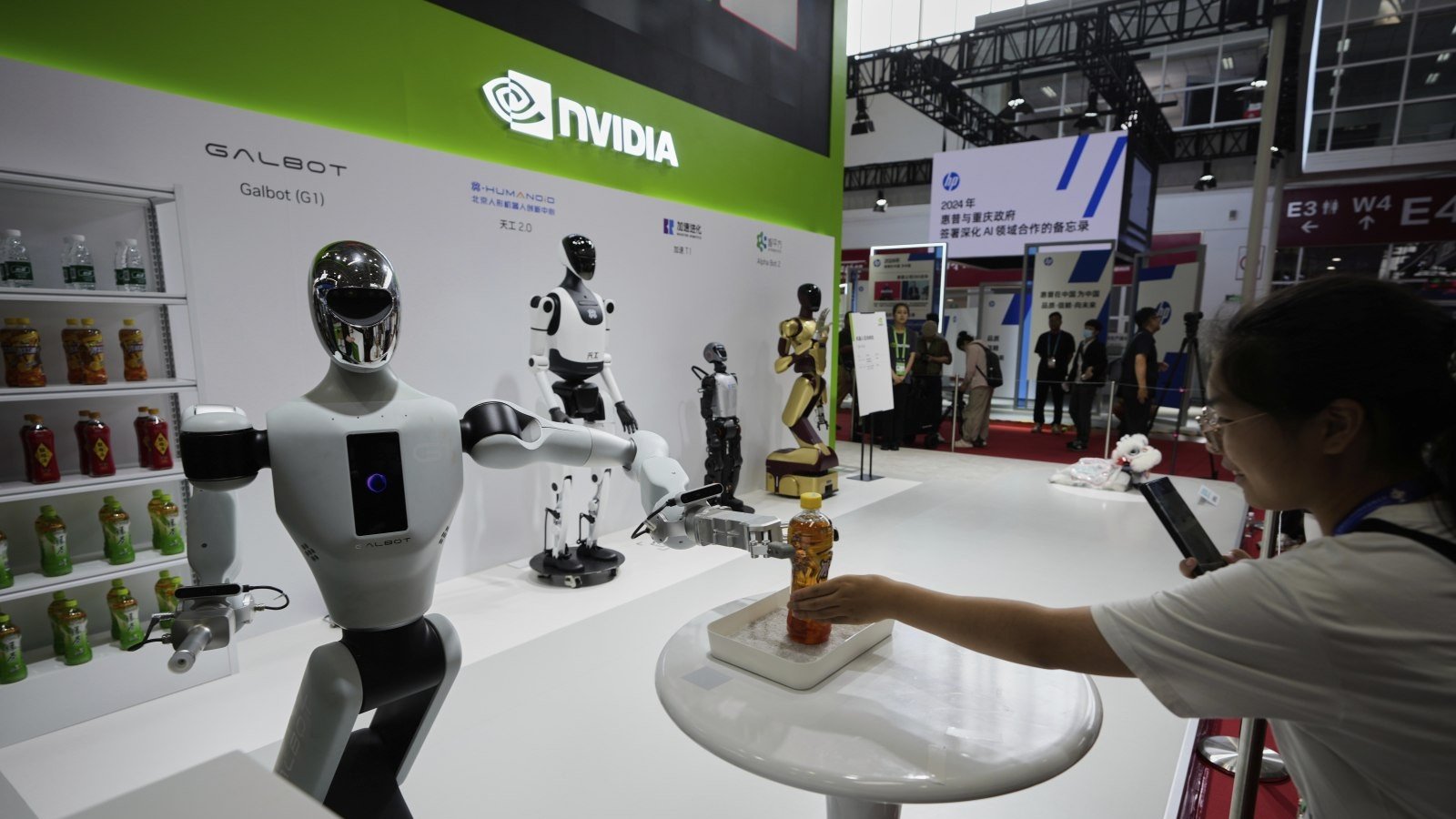
Nvidia has a quiet second act in artificial intelligence: wiring its chips into the real world, for robots, self-driving cars and drones. It’s worth about $10 billion a year — still a rounding error next to the $303 billion the company took in over the last four quarters — but CEO Jensen Huang calls the “physical AI” business the next decade’s growth engine and expects it to grow tenfold.
The customer base is a surprise to those tracking export controls: much of it is China. The country shipped roughly 90 percent of the world’s humanoid robots in the first half of this year, and Chinese makers — Unitree, Agibot, Fourier — are still training and running on Nvidia silicon even as they hedge with home-grown alternatives.
The playbook is the same one built Nvidia: pair a chip (Thor for robots) with a software stack (the open-weight GR00T and Cosmos models), and lock in developers over time. “Physical AI gives Nvidia a path from data centers into the much larger physical economy — vehicles, factories, warehouses and robots,” said Michael Frank of Radiant Intel. U.S. export controls bar Nvidia’s top-end AI chips to China, but trade in the robot and car chips remains open, giving the company a lane into the world’s biggest industrial-robot market.
The effort now runs the family. Huang’s daughter Madison is overseeing marketing for the physical-AI division and his son Spencer is a product-management director; Madison’s recent Beijing robotics tour drew crowds of its own. Nvidia says it “works with companies around the world consistent with U.S. laws” — and the open models it’s handing out are aimed at making sure the next decade of robot brains is written in Nvidia’s stack, not someone else’s.