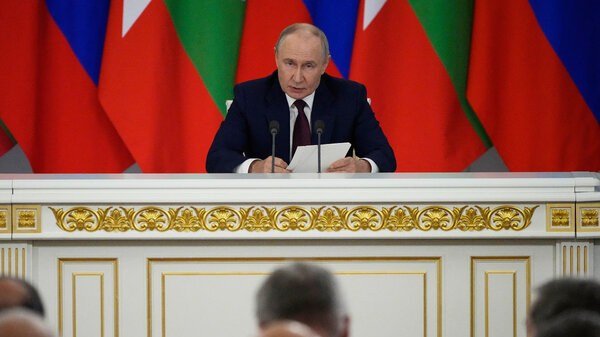
In his fifth year of war, difficulties are mounting for President Vladimir V. Putin of Russia. His troops have slowed on the battlefield. His spending on the war has ballooned beyond expectations. His population is increasingly fearful of what’s next. And his ability to project control has been undercut by Ukrainian strikes across Russia, with e-commerce warehouses, oil refineries and other facilities going up in flames on a near daily basis.
The situation has deteriorated to the point that the C.I.A. director, John Ratcliffe, made a rare visit this week to Moscow, where he laid out a bleak military and economic reality for Mr. Putin’s intelligence officials and urged the Russian government to cut a peace deal.
But Mr. Putin has shown little indication that he intends to stop fighting or believes his predicament is too gloomy to bear. Instead, he has suggested that despite Moscow’s challenges, he believes Kyiv’s situation is worse. He has warned that Ukraine “let the genie out of the bottle” by targeting Russia’s civilian economy and will get its due with a Russian escalation already underway.
“In his assessment, Russia needs to do just better than Ukraine,” believing that Kyiv “is going to crumble” eventually if he just holds on, said Alexander Gabuev, director of the Carnegie Russia Eurasia Center in Berlin. Mr. Putin has consistently underestimated Ukrainian resilience, Mr. Gabuev said. But Kyiv is indeed facing new perils — dwindling reserves of soldiers and military funds, plus severe air-defense shortages as the Iran war has depleted interceptor stockpiles.
Moscow each month is churning out dozens of ballistic missiles, formidable weapons that Ukraine lacks. According to Ukrainian military intelligence, Russia is also turning to North Korea for added ballistic missile power. Mr. Gabuev said the imbalance may be convincing Mr. Putin that he is gaining a critical advantage, and that he will seek to “break” Ukraine this winter by decimating its civilian infrastructure and military production facilities.
As he presses on, Mr. Putin is moving to consolidate domestic control, tightening political pressure and framing the war as a matter of existential necessity. Whether his strategy will survive contact with economic reality — and the growing cost of a war that now consumes a quarter of Russia’s budget — is the central question for the rest of 2026.
Source: “Why Putin Is Fighting On, Even as His Problems Multiply”, The New York Times, August 28, 2026. By Paul Sonne, reporting from Berlin.